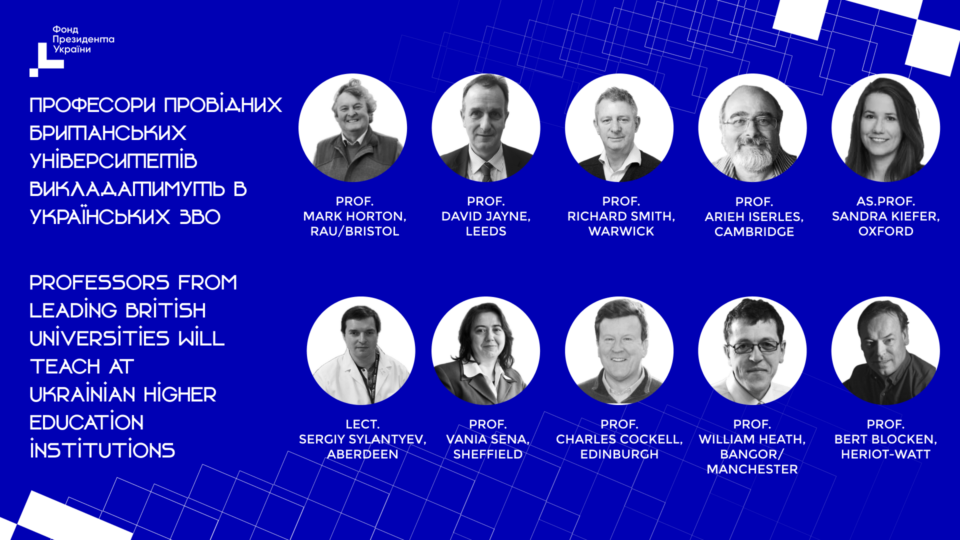
Khmelnytskyi National University has joined the prestigious international UK–UA Visiting Professors Programme, opening up new opportunities for the development of education and science in Ukraine.
The UK–UA Visiting Professors Programme is aimed at strengthening STEM education (science, technology, engineering, and mathematics) in Ukraine, which is critically important for the development of innovation, engineering, energy, and the country’s reconstruction. The project brings leading professors from top UK universities to teach and collaborate on research at Ukrainian higher education institutions.
As early as May, Professor William Heath will visit the University. He is an expert in automatic control, digital control systems, and energy systems. He heads the School of Computer Science and Engineering at Bangor University and also collaborates with Newcastle University and the University of Manchester.
His work at the University will focus on computer science and engineering. The professor will deliver lectures, conduct thematic workshops and research seminars, and contribute to the development of joint research projects together with faculty members and young researchers at Khmelnytskyi National University.
In addition to the educational process, the cooperation provides for the exchange of experience between Ukrainian and British academic schools, the preparation of joint publications, and the establishment of long-term academic partnerships.
We are confident that participation in the UK–UA Visiting Professors Programme will provide a powerful impetus for the further development of Khmelnytskyi National University. The involvement of a British professor means not only new knowledge and modern teaching approaches, but also the strengthening of international academic ties, expansion of research opportunities, and the creation of a qualitatively new educational environment. Such cooperation opens up prospects for professional growth for students and faculty alike and once again confirms that Ukrainian education is confidently integrating into the global scientific community despite all current challenges.