Kateryna Skyba, Vice-Rector of Khmelnytskyi National University and Professor, continues her work as a trainer-mentor in the international THEA Ukraine Lead project. Having completed her work with the first cohort, she is now supporting participants in the second cohort, helping them develop and implement change projects at their universities.
THEA Ukraine Lead (Training for Higher Education Administrators and Leaders in Ukraine) aims to strengthen the management and leadership competencies of senior staff at Ukrainian higher education institutions. The project is implemented by Münster University of Applied Sciences (FH Münster, Germany) in cooperation with Sumy State University. It is funded by the German Academic Exchange Service (DAAD) with support from the German Federal Ministry of Research, Technology and Space (BMFTR).
The programme focuses on preparing leaders who can drive change during wartime and contribute to the recovery of Ukrainian higher education. Its training combines strategic management, leadership, international relations and professional networking. Each participant works on an institutional project, while mentoring helps them apply the tools and approaches gained through the programme to the specific needs of their university.
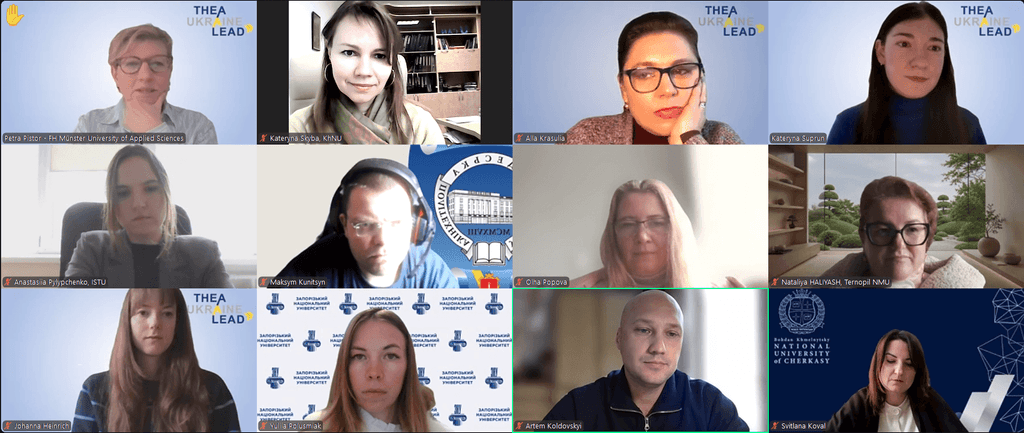
Kateryna Skyba with the THEA Ukraine Lead team and participants during an online workshop on 16 October 2026.
Participation and Mentoring Experience
Kateryna Skyba’s journey within the THEA community began in 2022, when she participated as a mentee in the earlier THEA Ukraine X project. The experience soon led to practical outcomes at KhNU: on 5–8 December 2022, she delivered the Internationalisation Booster course for deans and heads of departments. Participants worked on internationalisation plans for their respective units. In 2024, Kateryna Skyba joined the next THEA Ukraine X cohort as a tandem trainer, and in 2025 she became a trainer-mentor in THEA Ukraine Lead.
In the first THEA Ukraine Lead cohort, she mentored the Staff Development group. Its five projects focused on communication and teamwork, gender equality and inclusion, staff well-being, challenging stereotypes in education, and talent development and retention. They shared a common focus on people whose contribution determines universities’ ability to operate and develop during wartime.
At the final meeting on 8 October 2026, participants in the first cohort presented their projects and discussed implementation challenges, lessons learnt and recommendations for subsequent groups. An important aspect of the mentoring process was helping participants refine their objectives, take colleagues’ needs into account and identify realistic steps for implementing change alongside their day-to-day responsibilities.
Training for the second cohort began on 14–16 October. Kateryna Skyba became the mentor of the Innovative Academic Practice & Research Ecosystems group, which focuses on innovative academic practices and research ecosystems. Working with the new group continues the exchange of experience between universities and supports new initiatives developed by their management teams.
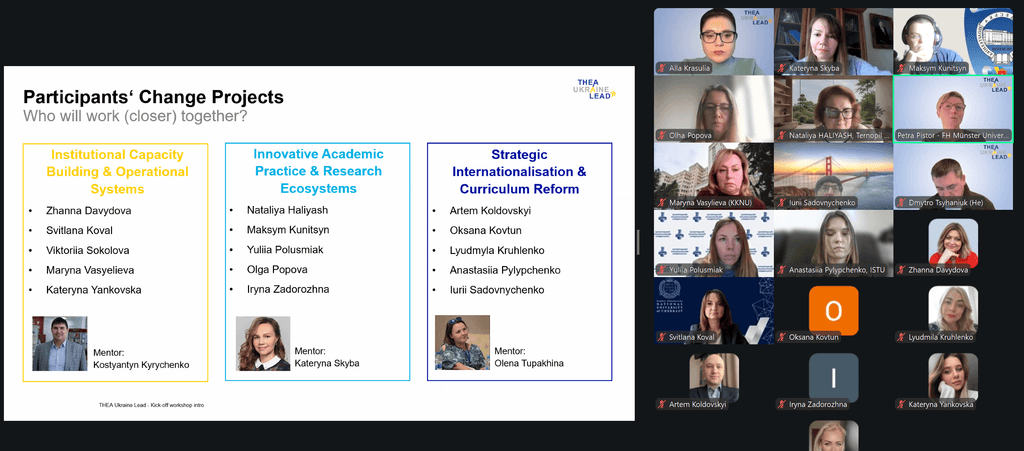
Introduction of the second cohort’s project groups. Kateryna Skyba is the mentor of the Innovative Academic Practice & Research Ecosystems group.
Topics That Help Universities Navigate Wartime Challenges
The second cohort’s opening workshop covered issues that higher education leaders face in their daily work. Professor Frank Ziegele led a session on strategic management. This topic is particularly important for Ukrainian universities, which must align long-term goals with available resources, security conditions and the needs of their academic communities. A strategy should help institutions set priorities and make decisions even as circumstances change.
The second day focused on leadership. Together with Dr Kai Handel, participants explored the fundamentals of leadership, while Petra Pistor led a session on personal values and self-leadership. These discussions help participants reflect on their managerial roles, ways of working with teams and responsibility for decision-making. Meetings between project groups and their mentors enabled participants to connect these topics with their individual project ideas.
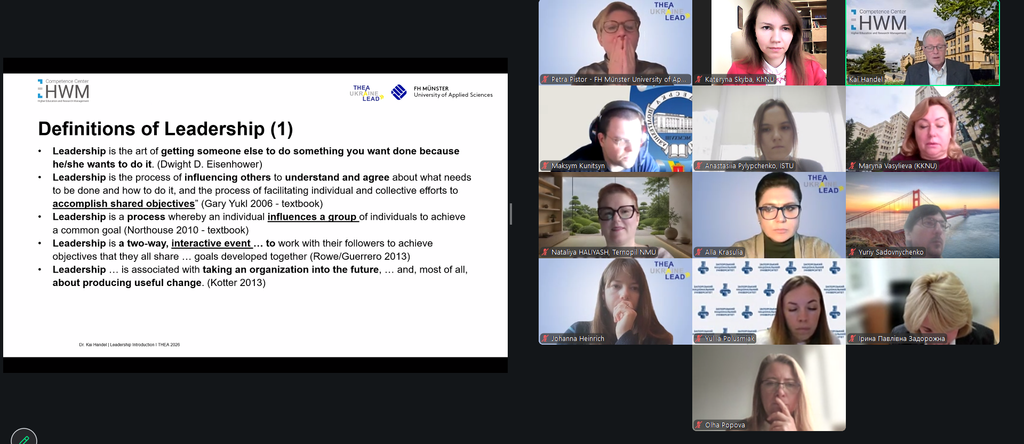
A session on the fundamentals of leadership during the THEA Ukraine Lead workshop on 15 October 2026.
The third day focused on how higher education institutions operate in emergencies. Kateryna Suprun presented experience from humanitarian practice and approaches to scenario planning. Participants explored how universities can prepare for several possible developments and maintain their core functions during a crisis. A practical case study from Sumy State University, presented by Alla Krasulia, added a Ukrainian perspective on crisis management to the discussion.
Together, these topics provide a foundation for responsible leadership: understanding an institution’s development priorities, supporting people and adapting working methods when necessary. Mentoring helps participants translate these approaches into their own change projects.
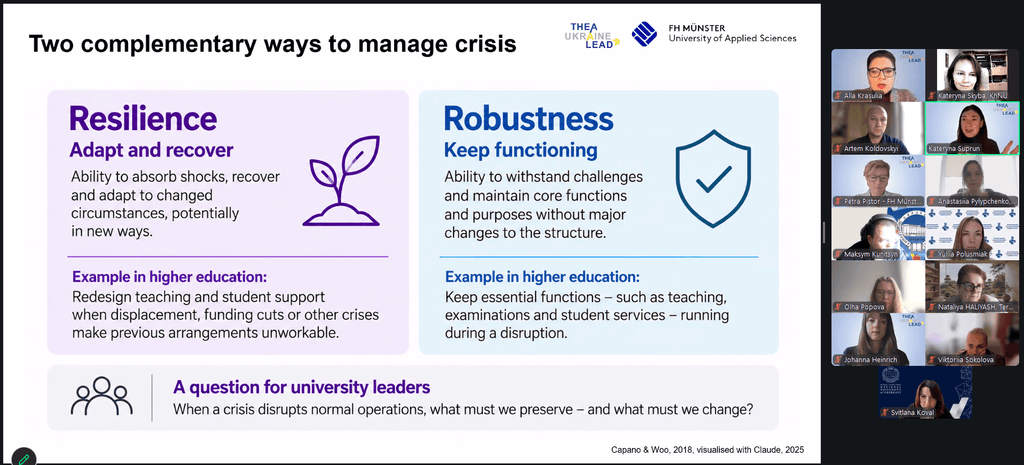
Discussion on universities’ capacity to adapt to crises and maintain their core functions. Kateryna Skyba takes part in the session on 16 October 2026.
Applying THEA Experience at KhNU
The experience gained through THEA contributes to the strategic development of Khmelnytskyi National University. KhNU’s new Internationalisation Strategy for 2026–2030 notes that its development took into account the university’s experience and outcomes from participation in THEA Ukraine, alongside other international programmes.
The strategy establishes a commitment to internationalisation for all, shared responsibility across university units, realistic objectives and partnerships based on mutual value. It provides for annual planning at faculty and department level, the development of staff members’ international competencies and the evaluation of results. These measures create the conditions for the systematic application of international experience across the university.
The connection with THEA’s approach is also evident in its vision of university leadership: engaging colleagues in shared goals, supporting their initiatives, developing teams and taking responsibility for results. Kateryna Skyba’s participation in the programme and her mentoring work help promote these approaches at KhNU.
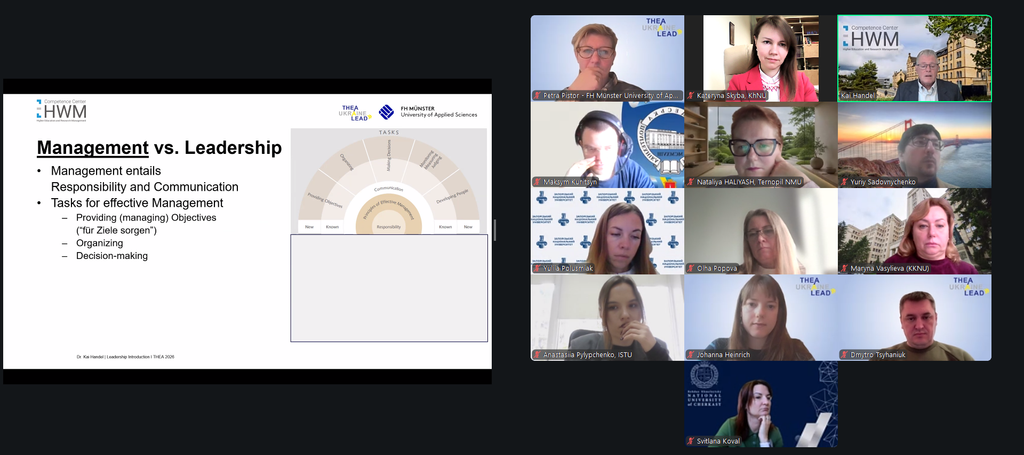
Discussion of university management and leadership during a session on 15 October 2026.
THEA Ukraine Lead is an important platform for preparing change leaders in Ukrainian higher education. Its value lies in the opportunity to address universities’ real needs, receive support from colleagues and test management decisions in practice. Kateryna Skyba’s journey from mentee to mentor demonstrates how experience can be shared across the professional community and serve as a foundation for new projects. Khmelnytskyi National University is grateful to the FH Münster team, Sumy State University and DAAD for their continued support for the development of Ukrainian higher education institutions.